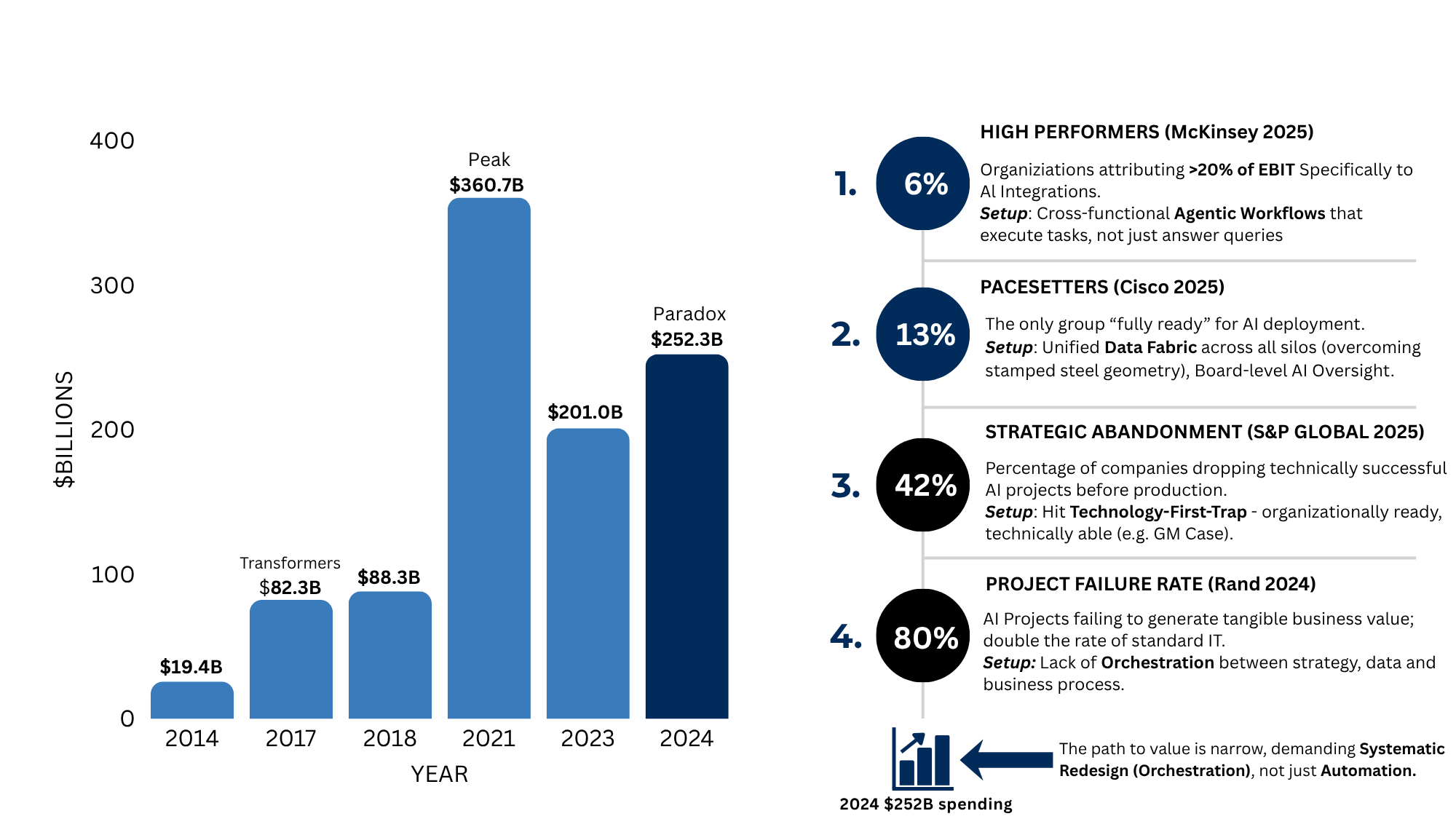
A peer-reviewed model for diagnosing enterprise AI capability across five pillars and three developmental stages. Why 80% of AI projects fail — and what the other 20% do differently.
Organizations are spending more on AI than at any point in the technology’s history. Cisco’s AI Readiness Index reports that half of organizations with more than 500 employees now allocate 10% to 30% of their total IT budgets to AI, and 92% plan to increase their AI investments over the next three years.
Yet readiness scores are declining, project abandonment is rising, and nearly half of business leaders report no gains or results below expectations. McKinsey’s 2025 global survey of nearly 2,000 respondents found that just 1% of C-suite leaders describe their generative AI deployments as mature. S&P Global reports that the share of companies abandoning the majority of their AI initiatives before production rose from 17% to 42% year over year.
AI project failure is fundamentally an organizational learning problem — not a technology deficit.
Israeli and Ascarza describe this in Harvard Business Review as a “technology-first trap”: organizations deploy AI solutions department by department without linking them to enterprise goals, producing technically successful implementations that never reach production. The classic case: General Motors applied generative-design software to produce a seat bracket 40% lighter and 20% stronger than the original, yet the part never entered production because GM’s supply chain, built for stamped steel, could not accommodate the AI-generated geometry. The technology worked. The organization was not ready.
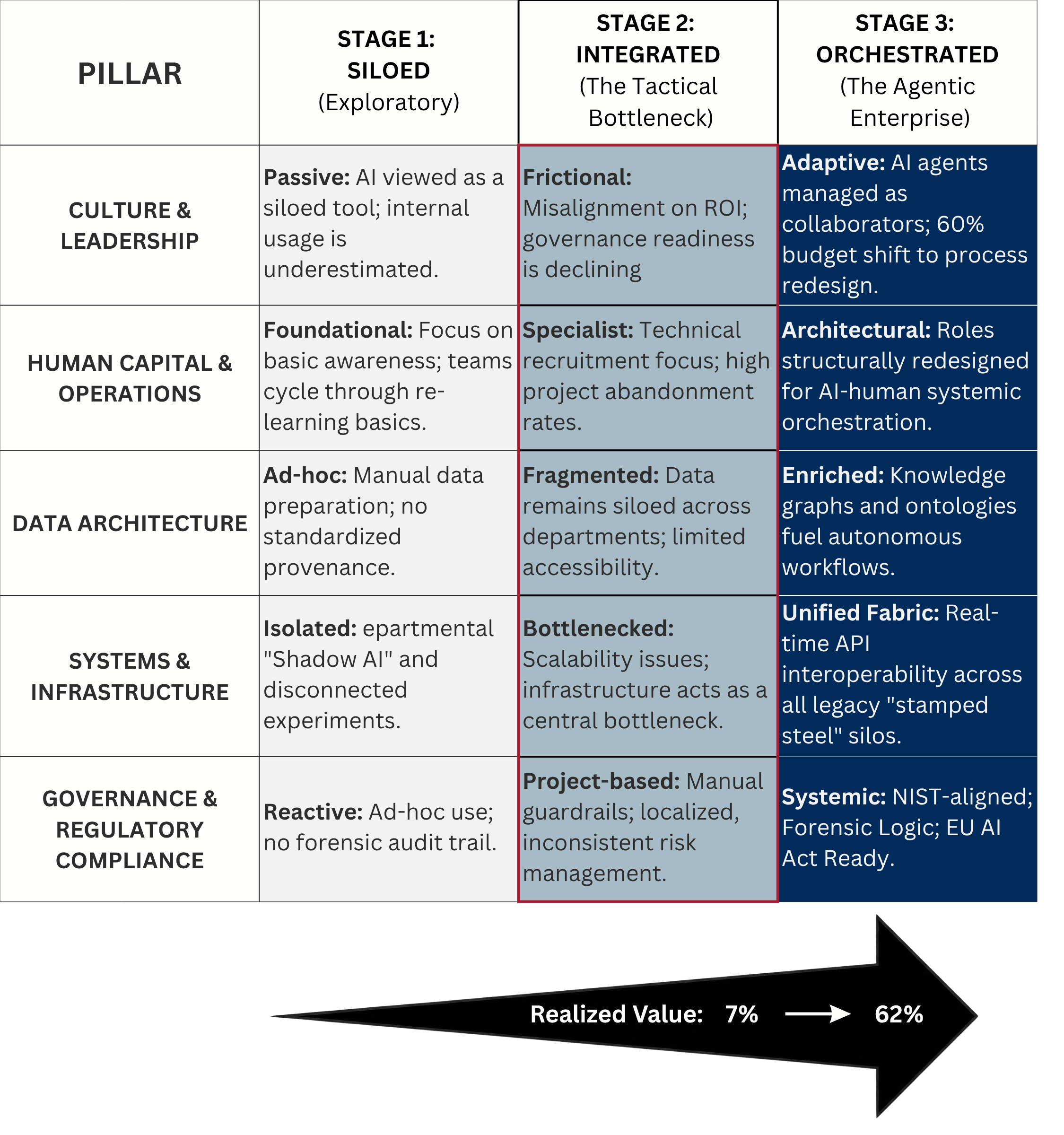
The framework maps enterprise AI capability across five interconnected pillars and three developmental stages. Where you are on the progression determines what you need next — static checklists don’t capture this distinction. The framework does.
Ad-hoc, isolated experiments. Shadow AI. Each initiative re-learns foundational skills. Up to 90% of effort lost on manual data preparation.
Pilots exist but stall before production. Only 26% move past proof of concept. Fragmentation across boundaries becomes the bottleneck. Most organizations are stuck here.
AI embedded in how work gets done across the enterprise. Cross-functional governance. AI agents managed as coworkers requiring onboarding, performance oversight, and structured oversight.
High-performing organizations are 2.8× more likely to have fundamentally redesigned their workflows and governance structures to reach the Orchestrated stage. The cost of inaction is compounding: traditional AI adoption has climbed to 72%, agentic AI has reached 35%, and 76% of leaders now view agentic AI as more like a coworker than a tool. Organizations that haven’t built foundational readiness must now develop Siloed-stage capabilities while competitors navigate Orchestrated-stage demands.
The paper closes with five prescriptive implications. The short version:
Reframe the problem before investing in solutions. If the barriers you face involve cross-functional alignment, misaligned incentives, or capability gaps across roles, additional technology alone will not resolve them.
Assess where you are on the progression, not just what you have. A Siloed-stage organization struggling with shadow AI faces a fundamentally different problem than an Integrated-stage organization struggling to scale pilots. Generic readiness checklists miss this.
Ensure the enablement capability exists at the right altitude. If 62% of AI value originates in business functions and 84% of failures trace to leadership-driven causes, the capability to drive AI readiness must have cross-functional authority — not live inside a single department.
Recognize that the cost of inaction accelerates. The window for building foundational readiness is narrowing.
Match measurement to maturity. Organizations that measure only cost savings will optimize for incremental gains. Measurement frameworks should evolve from input metrics at Siloed to outcome metrics at Orchestrated.
The Orchestration Maturity Diagnostic places your organization on the progression and identifies your binding constraint. Two ways to start.
McClure, J., & Gerdau, G. (2026). Why AI Readiness Is an Organizational Learning Problem, Not a Technology Purchase: The Structural Evolution of Enterprise AI Capability. Working paper, SSRN. papers.ssrn.com/sol3/papers.cfm?abstract_id=6600899